
History of File Sharing: Fun Facts
The concept of digital file does not originate from the commodity “file”.
Often, it is easy to think that the etymology of digital files comes from office supplies for binding documents. This is because we expect that it was intentionally chosen to explain invisible virtual concepts using familiar physical objects. However, the facts are this. In the early 1940s, a physical bundle of paper (punched cards) storing digital information was called a 'file'🔗. At that time, digital information was something people could see and touch. You could even manipulate the data by hand (by drilling holes!). Heavy files were literally heavy. A 1MB file weighed nearly 30kg. In this era, file transfer was no different from courier delivery. Also, unless copied over a long period of time, one file could not exist in two places at the same time. You can't imagine it now, but once the file transfer is complete, the original is completely gone from where it came from.
At one time, there were only files, no folders.
Magnetic tape, introduced in the 1950s, enabled high-speed copying and dramatically reduced transmission energy. However, it could only read in one direction, and a computer could only read one file at a time. After the advent of magnetic disks and the ability to read them quickly, files finally became a modern concept. However, as the number of files increased, management became more complex, and a hierarchical file system appeared in 1969🔗.
For over 30 years, people have been transferring files using the sound of their phone.
In the late 1970s, technology for transferring files over phone lines emerged🔗. If I picked up the phone during transmission, I could hear the file flow. This method was popularized as MODEM and was widely used until the early 2000s even after the introduction of the Internet.
At one time, file sharing programs were more popular than browsers.
The early Internet was very decentralized compared to today. There were many cases where the computer was turned on to operate an FTP server or use P2P software such as Napster or BitTorrent. Although these programs were very efficient and elaborately designed, they gradually disappeared due to copyright issues and lost to the convenience of the WWW.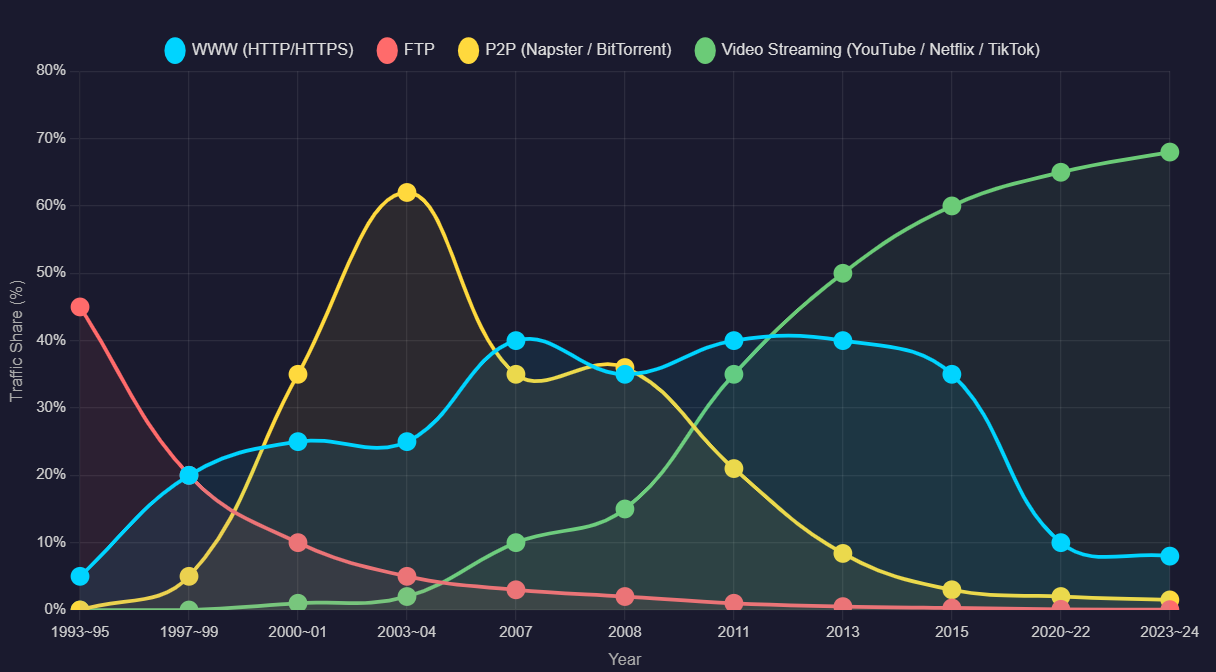
File transfer technology has not changed much compared to 20 years ago.
As WWW integrated all its functions, file transfer became an additional feature of the website. There are only two types: upload and download. All technologies implemented in P2P have disappeared. Users are left in an uncomfortable state. For example, if an upload fails, there is no standard technology to upload again.
file.kiwi was started to improve this. We use the best possible technology on the web to minimize inconvenience. It is for this purpose that file.kiwi provides a recovery function in case of upload or download failure.
You can see how current services have evolved through past file transfer methods. Now with a new perspective Start sharing files.